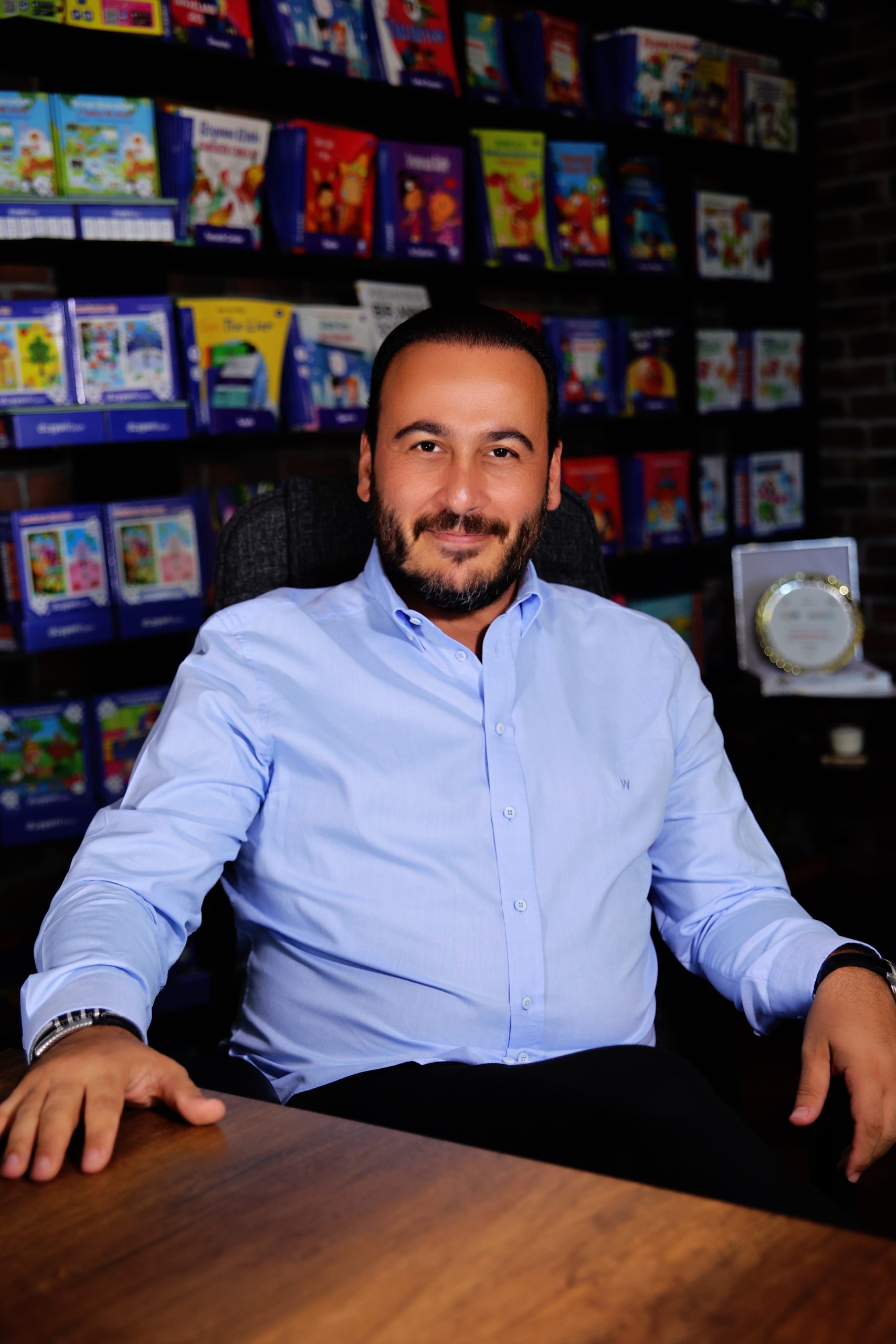
Through the “Conversations with Our Members” series, we have the opportunity to have an enjoyable conversation with one of the members of the Woman in Technology Association family, listen to their experiences, and learn about their relationship with technology. Our series continues with our Advisory Board Member, Co-Founder and CEO of Düşyeri, İbrahim Coşkuner. In our interview, Mr. İbrahim Coşkuner talks about his entry into the technology sector, what he gained from his start-up life, the beginning steps of Düşyeri, and Düşyeri receiving an award at the G20 summit with Uppy.
1. Could you briefly introduce yourself?
I started my professional career in 1999 in Pamukbank Alternative Distribution Channels. Later, I moved to the e-banking department of Pamukbank, where I managed products related to internet banking, TV banking, and SMS banking. Then, in 2005, I transferred to Finansbank. There, I established and managed the SME Banking CRM department. In 2007, I joined Embrio, which was affiliated with Teknoloji Holding, and worked on internet projects there. In 2008, I started working at Türk Ekonomi Bankası (TEB) in the SME Banking Product Development Department. At TEB, I became the founding manager of TEB Entrepreneurship Banking and TEB Entrepreneurship Houses (Girişim Evleri) in 2012. I was involved in the establishment of the Turkish entrepreneurial ecosystem. I established Entrepreneurship Houses in 10 cities across Türkiye, designed and implemented incubation and acceleration programs, and provided mentoring to over 2,000 start-ups to support their growth. In 2018, when I decided to become an entrepreneur, I became the managing partner of Düşyeri upon Ayşe Şule Bilgiç’s offer
2. What has your career journey been like so far? How did your path cross with Düşyeri?
When I was in charge of TEB Entrepreneurship Banking, Ayşe Şule Bilgiç participated in our GrowUp acceleration program. Within this program, we defined Düşyeri’s entire strategy and made plans for the product we now call Uppy. Then, we managed the first investment round of Düşyeri. With the closure of this round, according to Ayşe’s business plan, the first thing she needed to do was to build a new team. Ayşe offered me a partnership and the position of Managing Partner as she put this into practice. I remember that moment as if it were yesterday: “İbrahim, come and be my partner and take over Düşyeri. I’ll be the Minister of Dream Affairs, and you’ll be the Minister of Business Affairs,” she said.
At that time, I was already contemplating whether to start my own venture or become a founding partner in another promising start-up. I had received offers from 2-3 different start-ups in addition to Düşyeri. I accepted Düşyeri for two reasons. First, it was Ayşe. I would have an excellent partner. I believed we would make a strong team together, and that’s exactly what happened. Second, I would be doing something useful for the world and leave a lasting impact. So, I accepted it. I’m glad I did.
3. Can you tell us about your personal relationship with technology? How has technology changed you and your work in recent years?
I created my first software in 2000, while working at Pamukbank. I’m not originally from a software background, but at that time, I was working in Alternative Distribution Channels, specifically in the call center department. We needed a software program from the IT department for managing the outbound teams of the call center. The call center operations were entirely manual back then since call centers and outbound teams were just being established. IT had given us a deadline of 2 years for this request because it wasn’t considered a critical task for IT.
I said, “If you don’t do it, I’ll do it.” Back then, we had Visual Basic. .NET was slowly coming into play. I bought a Visual Basic book and started learning how to code. To my surprise, I had created Türkiye’s first outbound software five months later. This is when my relationship with technology improved for the first time. After that, I wrote three more programs, all related to the call center.
I had four programs that I wrote and were used at Pamukbank, apart from the IT department. Afterward, I moved to the CRM department at Finansbank. At Finansbank, I was on the business side. In the SME CRM department, I developed an excellent architecture for the IT department by utilizing my technology know-how. I brought a CRM system to life by designing all the screens, UI, and UX. I also developed a software called ‘Etkin Portföy Yönetimi (Effective Portfolio Management)’ during that time. This software analyzed the performance of all customer representatives in the branches and provided them with reports similar to prescriptions. It was like an early form of artificial intelligence. For a long time, the branches thought I was personally doing these analyses, but it was actually the program I had written that was doing them. Thus, I found myself constantly involved in both the technology and business side of things. On one side, I was technology-oriented, and on the other, I was business-oriented. This dual focus persisted throughout my entire career. I always distinguished myself and stayed up to date with my technology knowledge and skills.
In 2012, when I became the head of TEB Entrepreneurship Banking, my relationship with technology peaked because that’s when we started working purely with entrepreneurs in the technology field I listened to over 5,000 projects and mentored most of them. I believe I was one of the first people in Türkiye to listen to those projects, whether they were established, emerging, or in the development stage. All the start-ups came to us, presenting their projects, and it provided me with an incredible amount of know-how and a tremendous vision.
I can say that I have some knowledge about every area of technology, some in-depth, and some more superficial. When you have such a broad spectrum of knowledge and are nourished by entrepreneurs, you inevitably put this knowledge to use in your work.
4. With the Uppy application you developed, you received an award as the second-best Edtech start-up at the G20 summit in Bangalore, India. Could you share the story and importance of Uppy with us?
When I joined Düşyeri, Ayşe completely focused on academic research. This academic research took about 4 years. Ayşe delved into many research projects and examined both domestic and international studies. We were looking for an answer to the question, “What can we do that will be good for children and the world when they are aged 0-6?”
Why do we say 0-6? Because the age we focus on and excel in is 0-6. We’ve all heard that 85-95% of the human brain develops between the ages of 0-6. In our research, we found that words were the only thing that functionally developed the brain. Several researche studies indicate that “the more vocabulary a child has between the ages of 0-6, the more the brain grows functionally.” With every new word a child learns, thousands of neurons in the brain become active, other neurons start connecting through synapses, and the brain grows functionally.
There is a study called ’30 Million Words’ that has created quite a buzz worldwide. This study has shed light on the cognitive development disparities among children from low-income, middle-income, and high-income families. It reveals a threefold difference in cognitive development, even when looking at their vocabulary. If one child has learned 3,000 words by the age of 0-6, and another child has learned 4,000 words, the 1,000-word gap is referred to as the ‘word gap.’ In fact, during President Obama’s tenure, a campaign called ‘Close the Word Gap’ was initiated in the United States. Oxford University also has several projects related to ‘Close the Word Gap.’
Looking at the world’s biggest issue concerning children, cognitive development, the root of inequality is linked to income levels. We decided to find a method that could use the power of digital technology to uplift the cognitive and emotional development of every child, irrespective of their family’s income.
When asked, “Where are you conducting your research and development?” we replied, “Artificial intelligence and other technologies are advancing in many areas around the world. A lot of research and development is happening in those fields, but our research and development is unique. It is focused on how to enhance a child’s intelligence rather than artificial intelligence.” Here, artificial intelligence and other technologies serve as mere tools.
When we delved into the world of words, we found that countries like the UK and France have a state policy to teach 4,000 words to children aged 0-6. Germany has set this goal at 3,000-5,000 words, which corresponds to an average of 4,000 words. However, research by the Ministry of National Education (MEB) in Türkiye reveals an average of 3,000 words. Thus, we decided to solve this problem. We thought that if we want to ensure justice in the cognitive development of children, we needed to focus on this area, and created a Düşyeri Dictionary of 5,000 words. We categorized words from this dictionary into easy and challenging words. We created eight different content types for challenging words and a few pieces of content for easier ones.
We decided to teach 5,000 words through games, songs, books, activities, and many other types of content in Uppy. When we asked, “How can we achieve this?” we activated Düşyeri’s unique trait. Just like we did with Pepee, we mixed education into entertainment. By doing so, we can teach children a lot while they enjoy playing and having fun.
Throughout this process, we realized that children are not safe in the digital world. Our children are in a completely unknown and frightening digital environment. So, we thought, “Why not kill two birds with one stone?” We decided to provide children with a 100% safe digital world and, at the same time, teach them these words in every aspect of the world they encounter, thus taking their cognitive development to the next level. This is how Uppy was born.
When we look at the start-up ecosystem, Uppy is often referred to as a super app, but we prefer to call it a ‘child mode’. This child mode will turn into an operating system for children within the next 2-3 years. Uppy offers more than 130 games, and all of these games were designed with words in mind, as I mentioned earlier. As the Düşyeri team, we created all the content in Uppy over four years. I can confidently say that we have grown to the point where if we wanted to create spin-off start-ups from Düşyeri, we could easily generate around 60 start-ups.
When we presented Uppy at the G20, all the jury members in the field of education were already aware of the importance of the word gap and the difficulties children face in the digital world. With this awareness, they awarded us as the world’s second-best education technology company. The G20 process unfolded in the following way. One day, we received an email from the Republic of Türkiye Ministry of Industry and Technology. The email stated, “This year, the G20 will be held in India, and there are six important sectors for the world. One of these six sectors is educational technology. Each country’s ministry sends its best educational technology start-up to represent the country in India. We have chosen you as the Ministry. Would you represent our country?” We replied, “Of course, gladly,” and we proudly represented our country. And having done so, we returned with a very favorable outcome
5. As a member working alongside the Woman in Technology Association toward common goals, what message would you like to convey regarding gender equality in this age?
The Woman in Technology Association is truly an incredibly important organization, both for our country and the world. Under Zehra’s leadership, great things are happening here. In my approximately 19-year professional career, followed by 5 years in the start-up world, I have consistently observed the unfortunate reality that there are very few women within technology teams. This was also the case among start-up founders. I have encountered more than 5,000 start-ups, and, unfortunately, the number of women entrepreneurs, were and still is, very low.
I believe that the reason for this lies in the codes ingrained in us since our childhood. Since the concept of gender equality was approached differently as we grew up, certain things were ingrained in us. Due to these ingrained beliefs, we all began to move toward specific roles. Men started leaning towards more technical roles, while women were directed towards roles requiring soft skills. Statistically, this trend still holds. However, with today’s societal awareness, we can see that these codes are beginning to change.
For the past five years, we have been very mindful of this in all the content we create. We collaborated with Arçelik on the ‘he for she’ book, named ‘I Am Free to Be Myself.’ It includes a section on career choices. We pay extreme attention to gender equality in all our content.
Within our team, we also focus on female representation. However, when we look at university preferences, we see that women’s interest in working in the technology field is very limited, and the number of female graduates tends to be outnumbered by males. This is why the Woman in Technology Association has an incredibly important mission, thanks to the awareness campaigns it creates, the training it offers outside of universities, and the female tech experts it introduces into our lives as a result of these training programs. Therefore, we both support their efforts and take pride in being a part of the association.